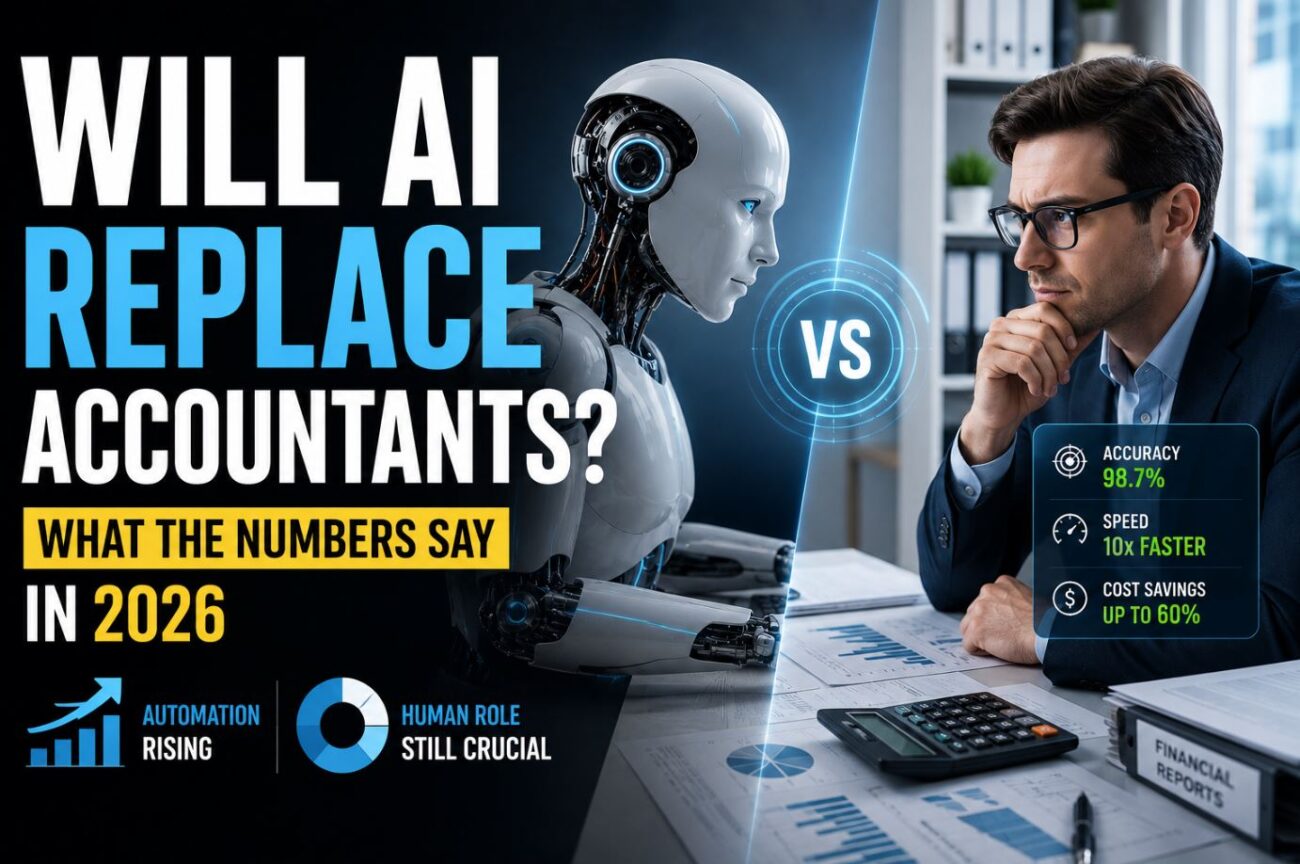
A partner at a mid-size accounting firm told me something last month that stuck: “I used to have four junior staff doing month-end close. Now I have two, and we close faster.” He didn’t lay anyone off — two people left and he didn’t replace them, because AI tools absorbed what they were doing. That’s the actual story of AI and accounting in 2026. Not mass replacement. Not zero impact. A quiet restructuring that’s hitting specific roles and specific tasks while leaving others untouched and actually expanding demand for others.
The headlines oscillate between “AI will eliminate accounting” and “accountants are completely safe.” Both are wrong. The real picture requires looking at which specific tasks are being automated, which job categories are growing versus shrinking, and what the actual labor market data says rather than what analysts predicted two years ago.
Quick Answer:
- The U.S. Bureau of Labor Statistics projects 5% growth for accountants and auditors through 2034 — faster than the average for all occupations — while separately projecting a 6% decline for bookkeeping clerks, explicitly attributing it to software automation
- The distinction matters: “accountant” and “bookkeeper” are different BLS job categories with opposite trajectories
- AI-skilled workers in business and finance earn a 56% wage premium over peers without AI skills — the profession isn’t disappearing, it’s bifurcating between those who use AI and those who don’t
The Numbers That Actually Matter
Before interpreting what’s happening, the data needs to be presented clearly — because most AI-and-accounting discussions conflate two different job categories that are moving in opposite directions.
The BLS tracks these separately:
Accountants and Auditors (1,579,800 jobs in 2024): Projected to grow 5% from 2024 to 2034, generating approximately 124,200 job openings per year. Growth is faster than the average across all occupations.
Bookkeeping, Accounting, and Auditing Clerks (1,613,400 jobs in 2024): Projected to decline 6% through 2034. The BLS explicitly states that “software innovations have automated many of the tasks” performed by these workers.
These two categories are almost identical in size but have opposite outlooks. The task mix is everything. A bookkeeping clerk who spends 70% of their week on data entry, transaction classification, and account reconciliation is working primarily in the high-automation zone. An accountant spending most of their time on tax strategy, audit judgment, and client advisory is working primarily in the low-automation zone.
The “will AI replace accountants” question has a different answer depending almost entirely on which of these two categories you’re asking about.
(Sources: U.S. Bureau of Labor Statistics OOH 2024-2034 projections | Thomson Reuters 2026 AI in Professional Services Report | Stanford GSB Choi & Xie study | PwC Global AI Jobs Barometer 2025)
What AI Is Actually Automating Right Now
Thomson Reuters’ 2026 AI in Professional Services Report found 69% adoption of AI among tax and accounting professionals — up from 22% just one year earlier. That’s not gradual adoption; that’s a structural shift happening faster than most labor market transitions.
The tasks with the highest current automation rates:
Already substantially automated at many firms:
- Transaction categorization and classification
- Invoice matching and accounts payable processing
- Bank reconciliation
- Document extraction from scanned files and PDFs
- Standard tax return preparation for straightforward filings
- Preliminary error flagging in financial statements
- Generation of routine management reports
Increasingly AI-assisted but still human-supervised:
- Tax research (69% AI adoption per Thomson Reuters 2026)
- Financial statement analysis
- Audit sampling and anomaly detection
- Cash flow forecasting
Remaining primarily human-driven:
- Complex tax planning with non-standard situations
- Audit opinion formation — CPAs carry legal liability for signed opinions that software cannot
- Client advisory requiring contextual judgment about a specific business
- IRS representation and regulatory compliance decisions
- Valuations in contentious situations
- Decisions carrying professional liability
QuickBooks’ agentic AI, launched in 2025, automatically creates and sends invoices, tracks and reconciles transactions, and follows up on payments — tasks that junior accounting staff spent significant billable hours on two years ago.
The Stanford Study: What Actually Happens When Accountants Use AI
A Stanford Graduate School of Business study by Professor Jung Ho Choi and Dr. Chloe Xie provides the most rigorous data on what AI actually does to accounting productivity when controlled for quality. The findings are more nuanced than either the optimistic or pessimistic narratives suggest.
Accountants who use AI support more clients per week and finalize monthly statements 7.5 days faster than those using traditional methods. They also spend 8.5% less time on routine back-office processing. Critically, reporting granularity increased 12% — AI helped firms maintain more detailed expense categorization rather than broad categories.
The performance gains aren’t uniform across experience levels, which is the finding most relevant to understanding who benefits and who’s at risk. Senior accountants treat AI as a collaborator — they’re more discerning, step in when system confidence drops, and apply human oversight where it’s most needed. Junior staff are more likely to accept AI outputs at face value, even when flagged as uncertain, and see smaller performance gains as a result.
The Stanford researchers’ conclusion: “The technology is not here to replace the human being — it’s here to augment the experts who are already in place.”
[COMMON TRAP] The framing of “AI replacing accountants” treats accounting as a monolithic job with uniform exposure to automation. In reality, an entry-level accountant spending 70% of their week on reconciliations and data entry has a very different risk profile than a senior CPA doing tax strategy and client advisory. The question isn’t whether your job title is “accountant” — it’s what specific tasks fill your actual working week.
The Talent Crisis That’s Changing the Equation
Any honest analysis of AI’s impact on accounting has to account for a simultaneous crisis on the supply side: the profession is losing experienced workers faster than it can replace them.
The numbers are striking. There are 340,000 fewer accountants working in the U.S. compared to 2019. Licensed CPA numbers have fallen from a peak of 1.93 million to 653,408 as of August 2025. CPA exam candidates fell 22.5% between 2017 and 2024. 75% of current CPAs are Baby Boomers approaching retirement age.
This demographic situation fundamentally changes what AI means for the profession. Rather than AI technology competing with a healthy supply of accountants, it’s increasingly filling a gap that human supply can’t close. Firms that can’t hire enough qualified staff are using AI not to replace people but to do more work with the people they have.
AI is increasingly a survival mechanism for understaffed firms, not a replacement strategy for fully staffed ones.
The Wage Premium for AI-Fluent Accountants
PwC’s Global AI Jobs Barometer 2025, based on analysis of nearly a billion job postings, found that AI-skilled workers in business and finance roles earn a 56% wage premium over peers without AI skills. AI-accounting specialist roles increased 26% with average salary premiums of $15,000–$25,000 annually.
EY announced a 10%+ salary hike for accountants as part of a $1 billion, three-year investment to reverse talent attrition. The Big Four firms aren’t cutting accounting staff — they’re competing aggressively to keep and attract accounting professionals who can work alongside AI tools.
The profession is bifurcating. Accountants who develop AI fluency are worth significantly more than those who don’t. Accountants who do primarily routine work that AI now handles are under real pressure. The job title “accountant” is becoming less predictive of career trajectory than the specific task mix of the role.
Which Roles Are Most and Least at Risk
Highest automation exposure:
- Bookkeeping clerks doing primarily data entry and reconciliation — BLS already projects a 6% decline
- Junior accountants whose week is mostly journal entries, reconciliations, and document review
- Tax preparers handling straightforward, standard returns
- Accounts payable/receivable processors doing primarily routine transaction matching
Moderate exposure with clear adaptation path:
- Entry-level staff at firms actively redeploying them toward advisory work and AI oversight
- Tax professionals doing research-heavy work (69% of this is AI-assisted but not fully automated)
- Audit staff doing sampling-based analytical work
Low automation exposure:
- CPAs carrying professional liability for opinions, representations, and compliance decisions
- Tax strategists working on complex, non-standard situations
- Client advisory roles requiring contextual business judgment
- Controllers and CFOs managing organizational financial strategy
- Auditors making final judgment calls on materiality and disclosure
What This Means Practically
Firms using AI are closing monthly books 30% faster and generating 25% more advisory revenue. The capacity freed by AI automation isn’t being redirected to layoffs in most cases — it’s being redirected to higher-value advisory work that charges 40-60% higher rates than compliance work.
The practical implication for someone building a career in accounting: the risk isn’t that AI replaces you, it’s that AI replaces the parts of the job that were the training ground for developing judgment. If junior accountants no longer spend years doing reconciliations and data entry, how do they develop the pattern recognition that makes senior accountants valuable? This is the more subtle career risk that the “replacement” narrative obscures.
The AICPA launched its Profession Ready Initiative in February 2026 specifically to address this transition — defining the skills early-career CPAs need when AI handles the tasks that traditionally built foundational competency.
For a broader look at which industries and roles are most affected by AI automation, the will AI replace your job tool runs the analysis by specific role and task mix. And for context on a parallel profession where the AI impact story looks different, will AI replace cybersecurity jobs covers a field where AI is creating more roles than it’s displacing at every experience level.
FAQ
Will AI replace accountants by 2030? No, not the profession as a whole. The BLS projects 5% growth through 2034. What will happen by 2030: continued decline in bookkeeping clerk roles, significant automation of routine compliance tasks, and growing demand for AI-fluent accountants who can work alongside these tools. The 340,000 CPA shortage makes broad replacement even less likely — the supply problem is already severe without removing more human accountants from the equation.
Are Big Four firms using AI to cut accounting headcount? No. EY, Deloitte, PwC, and KPMG are all investing heavily in AI tools while simultaneously competing for accounting talent with salary increases. Big Four firms are using AI to do more work with existing staff, not to reduce headcount.
Should accounting students be worried about the job market? The job market for CPAs and accountants is strong and growing. The concern is more specific: the traditional career path where you build judgment through years of doing routine work is changing. Students who develop AI fluency alongside technical accounting skills will be in a much stronger position than those who treat AI as irrelevant to the profession.
Is bookkeeping a dying career? Bookkeeping as traditionally practiced — primarily manual data entry, transaction categorization, and reconciliation — is being significantly automated. The BLS projects a 6% decline in bookkeeping clerk roles through 2034. Bookkeepers who transition to advisory-style work and AI tool management are adapting; those continuing to do exclusively manual data processing are in the highest-risk position.
What AI tools are accountants actually using? The most widely adopted in 2026: Intuit Assist (built into QuickBooks), Sage Copilot, Microsoft Copilot for Finance, and general-purpose AI assistants like ChatGPT and Claude for research summarization and document analysis. MindBridge is used for AI-powered fraud detection. DataSnipper handles document extraction for audit teams. The tools are embedded in existing workflows rather than requiring separate systems.
Conclusion
The honest answer to “will AI replace accountants” is: it depends entirely on what kind of accounting work you do. The BLS data shows accountants and auditors growing while bookkeeping clerks decline — a divergence driven directly by task automation. AI is already handling transaction classification, reconciliation, standard tax preparation, and document processing at scale. It isn’t handling tax strategy, audit judgment, professional liability decisions, or the client advisory work that grows when routine work gets automated. The profession isn’t disappearing. It’s restructuring. And the 56% wage premium for AI-fluent accounting professionals suggests the restructuring is creating opportunity for those who adapt — while the 340,000 CPA shortage means the market needs more qualified accountants than it has, AI or no AI.
