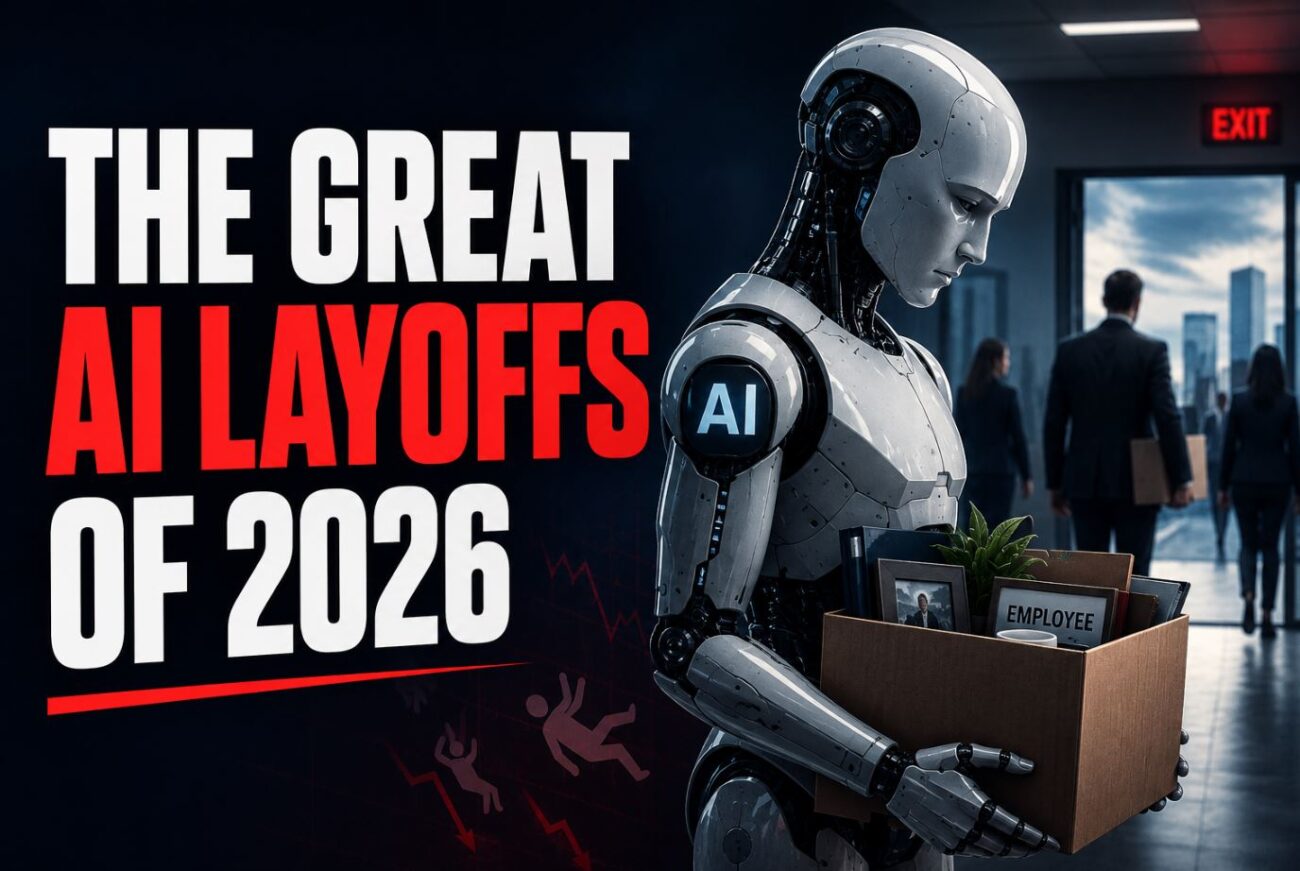
I started keeping a personal spreadsheet in March, tracking every layoff announcement that mentioned “AI efficiencies” or “AI-driven restructuring” in the press release. By the time Meta cut roughly 8,000 people in July and reassigned another 7,000 to AI-focused teams, my row count had passed 40 companies. I wasn’t trying to write a trend piece. I was trying to figure out if my own job, doing content and reviews at a mid-size tech site, was actually on that list or just adjacent to the panic.
Here’s what I found after going through Gartner’s own survey data, PwC’s labor numbers, and cross-checking against the actual layoff filings: the picture is messier and less doom-laden than the headlines suggest, but it’s also not nothing.
Quick Answer
- Tech industry layoffs attributed to AI have passed 100,000 in 2026, with Meta’s roughly 8,000-person cut in July being the largest single AI-restructuring event of the year so far.
- Gartner’s own data shows AI-driven layoffs don’t reliably improve company returns — roughly 80% of large organizations deploying autonomous AI tools cut headcount regardless of whether the deployment actually worked.
- The safest roles right now combine judgment, human relationships, or physical adaptability with domain expertise; the most exposed roles are the ones that were already standardized, repetitive, and easy to benchmark against an AI output.
What Actually Happened This Year
Meta’s cuts weren’t isolated. They landed on top of a year where over 100,000 tech jobs had already been attributed directly to AI automation, based on the layoff tracking I cross-referenced against Crescendo.ai’s running tally and individual company statements. Meta itself framed it as restructuring: about 8,000 roles eliminated, another 7,000 employees reassigned internally to AI-focused teams, and 6,000 previously open positions simply canceled instead of filled.
That distinction matters more than it sounds. A canceled open req doesn’t show up the same way in unemployment data as an active layoff, but it has the same effect on the job market: fewer entry points for people trying to get into tech.
[COMMON TRAP] Don’t read “AI-driven layoffs” as proof the AI tools actually replaced the work one-to-one. When I dug into Gartner’s survey numbers, the finding that stood out was almost backwards from the popular narrative: companies with strong returns from AI deployment and companies with weak or negative returns had nearly identical layoff rates. The cuts happened either way. That suggests a lot of these decisions are about freeing up budget, not about AI genuinely doing the work of the people let go.
The Two-Track Job Market Nobody’s Talking About Enough
PwC’s 2026 Global AI Jobs Barometer, which I read cover to cover after a friend in HR consulting sent it to me, describes something more interesting than a simple “AI takes jobs” story. It splits the labor market into two tracks.
Jobs getting “professionalized” by AI are roles where the technology raises the skill bar rather than replacing the person. These are growing twice as fast as jobs getting “democratized,” where AI makes the work easy enough that less-skilled people can do it, which shrinks the wage premium and the headcount both. The professionalized track also saw 42% faster wage growth since 2021, according to the same report.
Technology, Media, and Telecoms leads all sectors in AI hiring intensity, with close to one in eight new job roles now AI-related in that sector specifically. Manufacturing, somewhat counterintuitively, has a higher share of job postings requiring AI skills than Financial Services does, despite Financial Services generally getting more attention in AI-adoption coverage.
| Job Track | What Happens | Wage Trend |
|---|---|---|
| Professionalized by AI | Role requires deeper expertise, AI as a tool for experts | +42% faster wage growth since 2021 |
| Democratized by AI | Role becomes easier, AI does the standardized part | Slower headcount and wage growth |
Which Jobs Are Actually Exposed
I went back through the layoff announcements in my spreadsheet looking for patterns in job titles specifically, not just company names. The roles that kept showing up were ones that had already been simplified into repeatable steps before AI ever entered the picture: first-line customer support, junior content moderation, basic data entry and cleanup, entry-level coding tasks that amounted to boilerplate generation, and standardized financial reporting.
[PRO TIP] If you want a rough gut-check on your own exposure, ask whether your daily work output could be fully described in a two-page process document without losing anything important. Jobs that reduce cleanly to a checklist are the ones companies benchmark against AI output first. Jobs built around judgment calls, unpredictable client relationships, or physical dexterity don’t reduce that way, and that’s exactly why they’re harder to automate out.
The PwC data backs this up from a different angle: junior roles that are most AI-exposed are seven times more likely than less-exposed junior roles to now demand traditionally senior skills like leadership and independent judgment. Companies aren’t just cutting junior positions outright in the most AI-exposed categories — they’re raising the bar for who gets to keep one.
This split shows up clearly when you look at specific professions one at a time. I broke down exactly this dynamic for accountants a few weeks ago, and the same two-track pattern showed up again when I looked at insurance agents: the standardized end of both jobs is shrinking fast, while the advisory, judgment-heavy end is holding steady or growing.
Jobs Holding Up Better Than the Headlines Suggest
Therapists, teachers, nurses, skilled tradespeople, and social workers keep coming up as examples of roles unlikely to be fully replaced, and the reasoning tracks with what I’ve seen anecdotally among people in my own network. These jobs depend on empathy, trust built over repeated human contact, or physical adaptability that current AI systems simply don’t have a path to replicating cheaply.
That doesn’t mean these fields are AI-free. A nurse I talked to for a completely unrelated story mentioned her hospital had rolled out an AI documentation assistant that summarizes patient notes, which saves her real time. The AI didn’t reduce the headcount on her floor. It reduced the paperwork attached to each person already there.
(Tracked using: Windows 11 23H2 spreadsheet, cross-referenced against PwC’s 2026 Global AI Jobs Barometer, Gartner’s autonomous-technology adoption survey, and Crescendo.ai’s running AI news log)
Troubleshooting Your Own Risk Assessment
You keep hearing “AI-proof” advice that doesn’t match your actual day-to-day work. Most generic career advice right now assumes your job is either 100% creative judgment or 100% repetitive data entry. Almost nobody’s job is purely one or the other. Break your own role into its actual sub-tasks — the parts that are genuinely standardized versus the parts that require context only you have — instead of trying to categorize the whole job at once.
Your company announced “AI efficiencies” but you can’t tell if that’s really about your team. Check whether the announcement mentions specific tools or workflows, versus vague language about “leaner teams” and “restructuring.” Vague language, in my experience going through this year’s announcements, usually means the decision was budget-driven first and the AI framing came second, which doesn’t make it less real for the people affected but does change what kind of role would replace theirs later.
You’re being asked to “supervise” an AI agent doing your old tasks and you’re not sure if that’s a promotion or a downgrade. Look at whether the new responsibility comes with expanded judgment calls (deciding when the AI output is wrong, handling exceptions, owning the final decision) or just monitoring for errors on a fixed checklist. The first is closer to the “professionalized” track PwC describes. The second is closer to the track that keeps shrinking.
FAQ
How many tech jobs has AI actually eliminated in 2026? Layoff tracking through July puts AI-attributed tech job cuts at over 100,000 for the year, with Meta’s roughly 8,000-person reduction in July being the single largest event.
Do AI-driven layoffs actually improve company performance? Not reliably. Gartner’s survey found nearly identical layoff rates among companies with strong AI-driven returns and companies with weak or negative returns, suggesting many cuts create budget room rather than measurable business value.
Which jobs are safest from AI replacement? Roles depending on empathy, physical adaptability, or long-term human trust hold up best. Therapists, teachers, nurses, skilled tradespeople, and social workers are commonly cited examples.
Is AI creating any new jobs, or only cutting them? Yes. TMT leads all sectors in AI-related hiring intensity, and productivity growth is running about 40% higher at AI-exposed companies compared to companies with less exposure, according to PwC’s data. Some of those companies are raising headcount and wages faster, not just cutting.
What does “professionalized” versus “democratized” by AI mean? Professionalized jobs get more demanding and better paid as AI raises the expertise bar. Democratized jobs get easier and cheaper to fill as AI absorbs the standardized parts, which tends to shrink both headcount and wage growth in that category.
Should I be worried if my company just announced AI-related restructuring? Worth taking seriously, but check whether the language is specific (naming tools, workflows, or teams) or vague (generic “efficiency” language). The specificity tells you whether it’s a targeted automation decision or a broader budget move using AI as the explanation.
Conclusion
The layoff numbers are real, and Meta’s July cuts made that impossible to wave off as tech-blog exaggeration. But the data I went through doesn’t support a clean story of AI machines replacing people task-for-task. It supports something closer to a market splitting in two: roles getting harder and better paid because AI raised the bar on judgment, and roles getting easier and cheaper because AI absorbed the standardized parts. Which side of that split you land on has less to do with your job title and more to do with whether your actual daily work reduces cleanly to a checklist.
