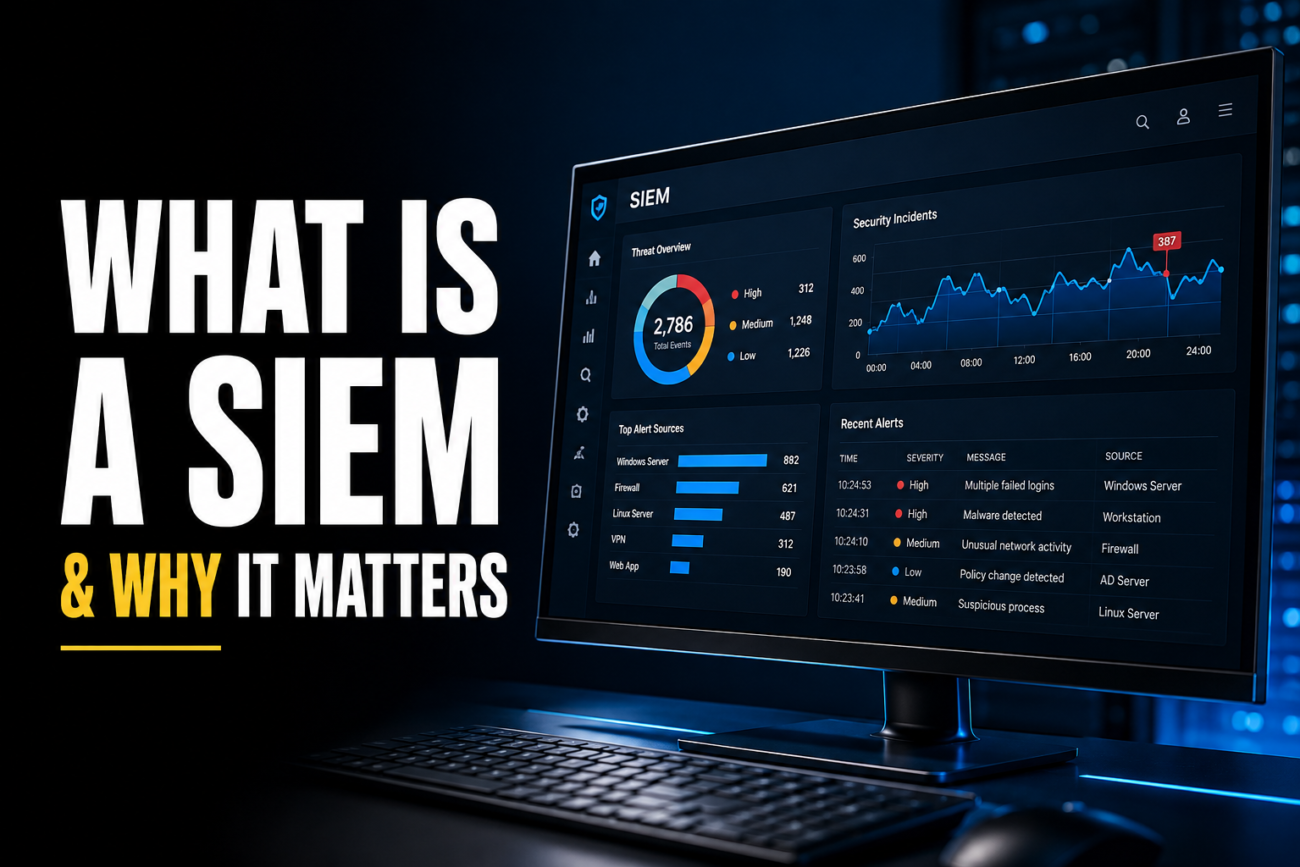
I remember scrolling through SOC analyst job postings when I was researching this career path for a reader question, and the acronym SIEM showed up in literally every single listing I opened, usually within the first two bullet points. Nobody bothered explaining what it actually was, they just assumed you already knew. If you’re trying to break into cybersecurity and keep seeing “SIEM experience preferred” without a clear picture of what that means day to day, this is the explanation I wish I’d had earlier.
Quick Answer
- SIEM stands for Security Information and Event Management. It’s the software platform that collects logs from every system across an organization, servers, endpoints, firewalls, cloud services, and correlates that raw data into alerts a human analyst can actually investigate.
- SOC analysts spend the majority of their working hours inside a SIEM dashboard, which is why job postings mention it constantly. It’s not one tool among many; it’s the primary workspace for the role.
- The most commonly requested platforms are Splunk, Microsoft Sentinel, and IBM QRadar. Splunk shows up most often in job listings, while Microsoft Sentinel and the free, open-source Wazuh have become popular starting points for building hands-on experience before landing a first role.
What a SIEM Actually Does
Without a SIEM, an organization’s security data lives scattered across dozens of disconnected systems. Firewall logs sit in one place, Active Directory logs in another, cloud service logs somewhere else entirely, and endpoint activity in a fourth system. No individual analyst could manually cross-reference all of that in real time to spot a coordinated attack unfolding across multiple systems at once.
A SIEM solves this by pulling all of that log data into a single platform, then applying correlation rules that flag patterns worth a human’s attention. If a login attempt from an unusual location is followed by unusual data access on a separate server ten minutes later, a SIEM can connect those two otherwise-isolated events and surface them together as a single alert, rather than leaving an analyst to notice the connection by chance.
[COMMON TRAP] Don’t assume a SIEM automatically catches every threat on its own. It’s a detection and correlation platform, not an autonomous defense system. The rules and correlations it runs are only as good as what’s been configured, tuned, and maintained by the security team behind it. A poorly tuned SIEM either misses real threats or buries analysts under so many false positives that genuine alerts get lost in the noise, which is exactly why SIEM tuning is its own ongoing skill, not a one-time setup task.
Why This Shows Up in Nearly Every SOC Job Posting
This isn’t job-posting inflation or keyword-stuffing. A Tier 1 SOC analyst’s actual daily work is, in large part, watching SIEM dashboards, triaging the alerts it generates, and deciding which ones warrant escalation. Industry breakdowns of the role consistently describe SIEM operations as one of the core technical skill categories required, alongside network analysis and log interpretation, because the SIEM is where nearly all of that work physically happens.
The specific platform requested varies by employer, but the underlying skill, being able to write queries, build alerts, and investigate flagged events inside a SIEM interface, is close to universal across SOC job listings regardless of which specific product a company has standardized on.
| Platform | Common Context |
|---|---|
| Splunk | Most frequently required in job postings; considered close to an industry standard |
| Microsoft Sentinel | Cloud-native, increasingly common, has a usable free tier for practice |
| IBM QRadar | Common in larger enterprise and government environments |
| Wazuh | Free and open-source; widely used for building hands-on experience before a first job |
[PRO TIP] If you’re job hunting and don’t have access to an enterprise SIEM license, don’t let that stop you from building real experience. Microsoft Sentinel’s free tier and the open-source Wazuh platform are both genuinely usable for hands-on practice, and pairing either with Sysmon on a Windows virtual machine to generate real telemetry gives you something concrete and specific to describe in an interview, rather than a vague claim of “SIEM familiarity” on a resume.
What Analysts Actually Do Inside a SIEM
The day-to-day work breaks down into a few recurring tasks that show up across nearly every SOC analyst description:
- Monitoring dashboards for alerts generated by the SIEM’s correlation rules, watching for anything flagged as suspicious across the organization’s systems
- Writing and refining queries to investigate a specific alert, pulling related log entries to understand what actually happened and whether it’s a genuine threat or a false positive
- Tuning detection rules so the SIEM generates fewer false positives over time, which becomes an increasingly important skill at Tier 2 and beyond
- Documenting findings in a ticketing system so the investigation is reconstructable by other analysts or auditors later
Increasingly, this also includes writing detection logic directly, not just responding to alerts someone else configured. Sigma rules, a vendor-neutral format for writing SIEM detection logic, have become a genuinely valuable skill to demonstrate, since a candidate who can write a rule detecting a specific MITRE ATT&CK technique stands out clearly from one who can only describe using a SIEM passively.
(Compared using: publicly available SOC analyst job postings across Glassdoor and Indeed, cross-referenced against Microsoft Sentinel’s free tier and Wazuh’s documentation for hands-on platform comparison)
Troubleshooting Common Confusion Points
You keep seeing SIEM, SOAR, and EDR mentioned together and aren’t sure how they differ. A SIEM collects and correlates log data into alerts. SOAR (Security Orchestration, Automation, and Response) takes those alerts and can automate parts of the response process, like isolating a compromised device automatically. EDR (Endpoint Detection and Response) is narrower in scope, focused specifically on individual devices rather than the whole organization’s log data. They’re complementary tools that often work together in a mature SOC, not competing options.
A job posting requires “SIEM experience” but you’ve never had access to an enterprise license. This is genuinely common for career changers, and it’s specifically why free tools like Wazuh and Microsoft Sentinel’s free tier exist as practical entry points. Building even a small home lab, generating your own log data, and writing a few detection rules gives you concrete, specific experience to discuss, which matters more in an interview than simply listing the acronym on a resume.
You’re unsure which specific SIEM platform to learn first. Splunk shows up most consistently across job postings and is often treated as close to an industry baseline, making it a reasonable first choice if you can access a free trial or training environment. That said, the underlying skills, log analysis, query writing, alert triage, transfer reasonably well between platforms once you understand the core concepts.
FAQ
What does SIEM stand for? Security Information and Event Management. It’s a platform that aggregates log data from across an organization’s systems and correlates it into actionable security alerts.
Do I need to know a specific SIEM platform to get hired as a SOC analyst? Not always a specific one, but demonstrable hands-on experience with any SIEM platform, even a free one like Wazuh or Microsoft Sentinel’s free tier, is considerably more valuable to employers than simply listing “SIEM” as a keyword without any practical experience behind it.
Is a SIEM the same thing as antivirus software? No. Antivirus and EDR tools operate at the individual device level, detecting and responding to threats on that specific endpoint. A SIEM operates at the organizational level, correlating data across many systems at once to spot patterns no single endpoint tool would catch alone.
How much of a SOC analyst’s job actually involves the SIEM directly? A substantial majority of daily work happens inside SIEM dashboards and query interfaces, particularly at the Tier 1 level, where monitoring alerts and initial triage make up the core of the role.
What’s the difference between a SIEM and a SOAR platform? A SIEM detects and correlates security events into alerts. A SOAR platform builds on top of that by automating response actions, like automatically isolating a compromised endpoint once a SIEM alert meets certain criteria, reducing manual steps during incident response.
Can I learn SIEM skills without paying for an enterprise license? Yes. Microsoft Sentinel offers a usable free tier, and Wazuh is fully open-source and free. Both are commonly recommended starting points for building genuine, demonstrable SIEM experience before landing a first SOC role.
Conclusion
A SIEM shows up in nearly every SOC analyst job posting because it’s not a peripheral tool, it’s the primary environment where the actual work of the role happens: monitoring, correlating, investigating, and documenting security events across an entire organization’s infrastructure. If you’re building toward this career, hands-on time with a SIEM platform, even a free one, matters far more than being able to define the acronym, since that’s exactly the kind of practical experience employers are actually screening for.
If you’re mapping out the broader path into this field, I covered the realistic timeline and requirements in transitioning from IT help desk to a Tier 1 SOC analyst role without a degree, and if you’re earlier in the decision process entirely, whether a cyber security career is realistic without any IT experience is worth reading first. You can also run your own numbers through the Cyber Security Salary Calculator to see how SOC analyst roles compare to other paths in the field.
