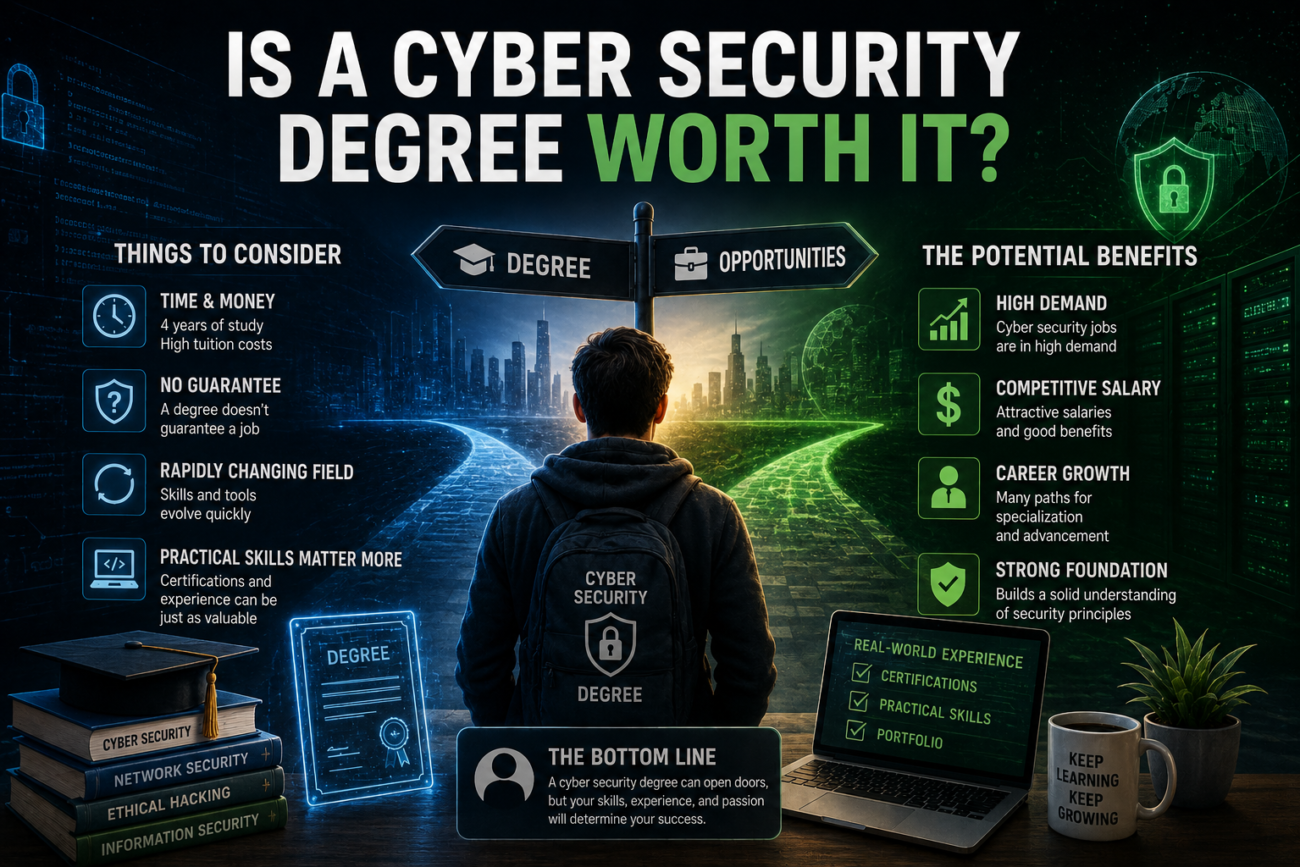
For most people aiming at hands-on technical roles, a certification path will get you employed faster and cheaper than a full degree, and several industry analyses now put certifications like CISSP or OSCP ahead of a degree on pure ROI for typical practitioner roles. A degree earns its cost back specifically when you’re pivoting from a non-technical background, targeting leadership roles like CISO, or aiming at specialized research or cryptography work where employers genuinely expect one.
The Honest Trade-Off
A four-year degree costs real time and real money, commonly tens of thousands of dollars even at public universities, and takes years before you’re job-ready. A certification like CompTIA Security+ costs a fraction of that, takes weeks to a few months of focused study, and is specifically built around the practical, job-ready skills employers are screening for in entry-level roles. Multiple recent analyses comparing the two conclude that for most practitioner-track roles, employers care more about demonstrated, certified skill than which degree sits on your resume.
That doesn’t make a degree worthless, it makes it a different tool for a different goal.
When a Degree Genuinely Pays Off
You’re pivoting from a non-technical background. If your resume doesn’t already show technical experience, a degree (or at minimum a technical associate’s program) helps establish the foundation that someone coming from IT or networking already has built on the job.
You’re aiming at leadership, not just practitioner roles. Positions like CISO commonly expect a degree, often a master’s, paired with substantial leadership experience and certifications. This is one of the few areas where the credential itself, not just the skill, tends to matter to employers.
You want research or cryptography specifically. These are the more academically demanding corners of the field, and a technical degree provides the theoretical grounding that practical certifications generally don’t cover.
Your specific employer requires it. Some organizations, particularly in finance, healthcare, and government, still list a degree as a formal requirement regardless of what certifications or experience you bring. Worth checking job postings in your target sector before assuming certifications alone will clear every door.
When Certifications Make More Sense
If your goal is a hands-on technical role like SOC analyst, security engineer, or penetration tester, and you either already have IT experience or are willing to build it alongside your certifications, the faster and cheaper certification path tends to get you employed sooner without sacrificing the long-run outcome. The U.S. Bureau of Labor Statistics reported a median annual wage of $124,910 for information security analysts as of May 2024, well above the median for all computer and IT occupations and more than double the median across all U.S. occupations, and that salary level is achievable through the certification path, not exclusively through a degree.
A Word of Caution on Where This Information Comes From
A lot of what you’ll find researching this question is published by universities and bootcamps with an obvious financial interest in the answer being “yes, enroll here.” Pages that frame a specific program as “the ideal choice” or promise guaranteed ROI are marketing copy first, objective analysis second, even when they include real statistics. The underlying data on salaries and job growth is genuinely useful; just read the framing around it with the knowledge that the source often has something to sell you.
The Middle Path: Both, Just Not at Once
Plenty of working professionals end up with both a degree and certifications over time, often starting with certifications to get employed faster, then adding a degree later if they’re targeting leadership or a specialized track. There’s no rule that says you have to pick one permanently at the start of your career. If you’re unsure how hard the underlying material actually is before committing to either path, our guide to how hard cyber security really is breaks down what the day-to-day learning curve looks like regardless of which route you choose.
FAQ
Will I get hired without a degree if I have certifications? Yes, for most practitioner-level technical roles. Many employers in this field weigh demonstrated, certified skill at least as heavily as a degree, sometimes more.
Is a master’s degree worth it specifically? Mainly if you’re targeting leadership roles like CISO, research positions, or specialized work like cryptography, where employers in those tracks commonly expect one. For general practitioner roles, the return is less clear-cut.
How much does a typical cybersecurity degree cost? Public university programs commonly run $10,000 to $25,000 in-state, and noticeably more out-of-state or at private institutions. Compare that against a certification path that can cost a small fraction of that and take a fraction of the time.
Can I switch from certifications to a degree later if I change my mind? Yes, and it’s a common path. Starting with certifications to get employed, then adding a degree later for a leadership pivot, is a normal sequence rather than a compromise.
Do certifications expire or need to be renewed? Many do, typically requiring renewal every few years through continuing education or a retest, which is worth factoring into the long-term cost comparison against a one-time degree.
Bottom Line
If your goal is a practical, hands-on cybersecurity role and you want to get there as efficiently as possible, certifications are very likely the better-ROI path right now. If you’re aiming at leadership, research, or a field that genuinely requires the credential, a degree still earns its place, just go in clear-eyed about why you’re choosing it rather than assuming it’s the only legitimate route into the field.
