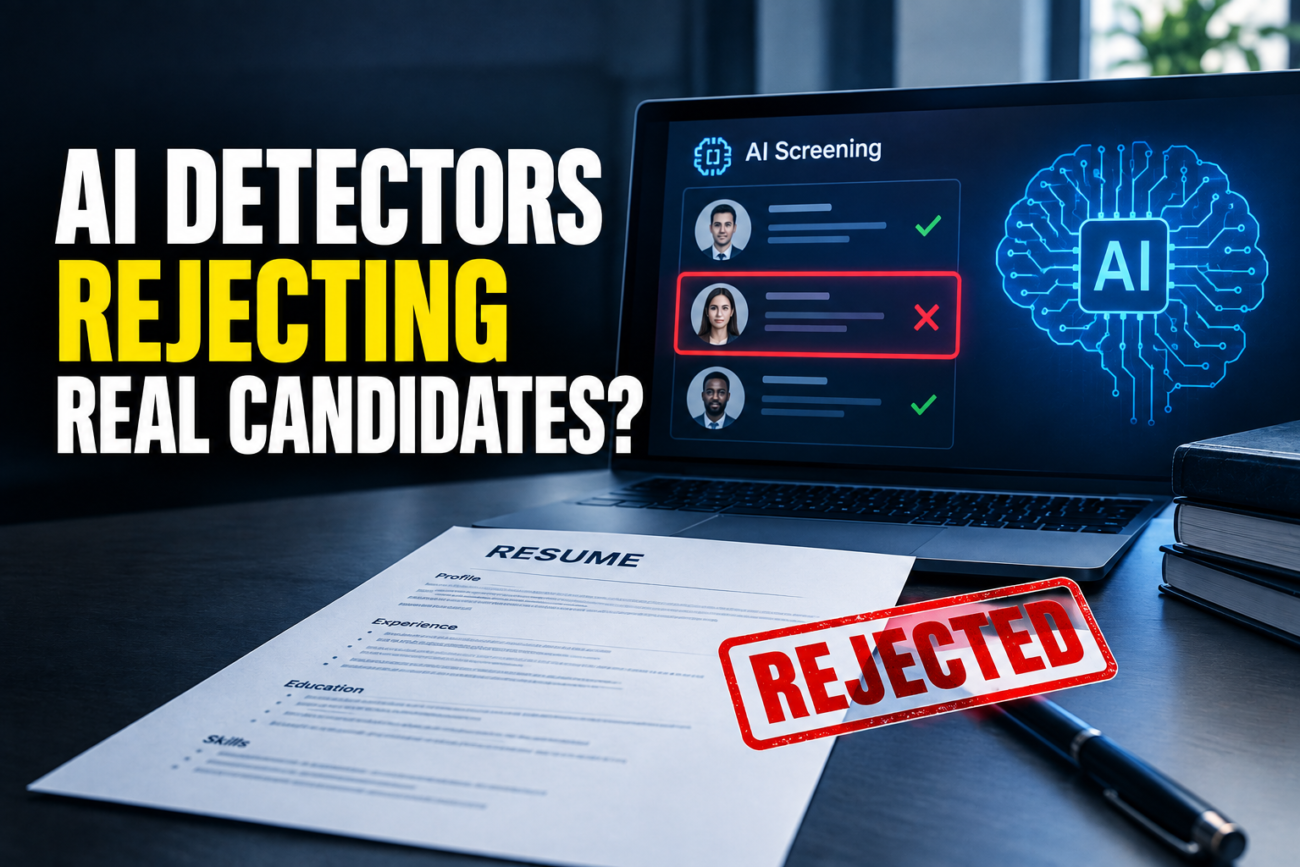
A friend finishing her MBA showed me a rejection email last month that felt off somehow, generic even by rejection-email standards, arriving less than an hour after she’d submitted a cover letter she’d genuinely written herself, just in the formal, structured style her program had spent two years training into her. I couldn’t prove an AI detector caused that particular rejection, but after digging into the actual research on how these tools perform, her instinct wasn’t unreasonable. The data on false positives is worse than most people assume, and it lands hardest on exactly the writers you’d least expect to be flagged.
Quick Answer
- Independent research consistently finds AI detectors produce meaningful false-positive rates on resumes and cover letters, with a Stanford study specifically finding a 61.3% false-positive rate on writing by non-native English speakers.
- A May 2026 audit of ten major applicant tracking systems, including Workday, Greenhouse, iCIMS, and Oracle, found that none of them natively detect AI-generated resumes, despite AI detection increasingly being marketed as a hiring feature.
- Third-party AI detector add-ons do exist and some recruiters use them, but the more common bottleneck remains the human recruiter’s 30-to-60-second read, not an automated AI-detection rejection most candidates assume is happening.
The Confusing Gap Between What’s Marketed and What’s Actually Deployed
This is genuinely where a lot of candidate anxiety comes from, and it’s worth untangling directly. Search around and you’ll find detector vendors advertising 99.99% accuracy with sub-5% false-positive rates, positioned specifically for recruiters. At the same time, independent audits of the actual hiring platforms companies use, Workday, Greenhouse, iCIMS, Oracle, SAP, Lever, Workable, SmartRecruiters, Ashby, and BambooHR, found none of them natively detect AI-generated content as of mid-2026. Both things are true simultaneously: dedicated detection tools exist and are improving, but they’re not built into the mainstream hiring pipeline most candidates are actually submitting applications through.
Only around 14% of hiring teams have deployed any dedicated AI detection software at all, according to research auditing hiring practices this year. That’s a real number of companies doing it, not zero, but it’s meaningfully smaller than the anxiety around this topic suggests.
[COMMON TRAP] Don’t assume every application rejection with no clear explanation was caused by an AI detector specifically flagging your resume. The far more common bottleneck remains a human recruiter’s extremely brief initial read, somewhere in the 30 to 60 second range, deciding whether to keep going based on specificity and clarity, not an automated AI-content rejection. Attributing every unexplained rejection to detection technology can lead candidates to focus on the wrong fix.
Why the False Positive Problem Is Genuinely Serious
Where AI detection is used, the accuracy picture is legitimately concerning, and it’s not evenly distributed across candidates. The often-cited Stanford research found a 61.3% false-positive rate specifically on writing by non-native English speakers, meaning well over half of genuinely human-written applications from this group risked being misclassified as AI-generated. Separate 2026 research found a gap of 23% false positives for non-native speakers versus 4% for native speakers using detectors trained primarily on native English text.
A second group gets caught in this net for a different reason entirely: candidates with advanced degrees. Formal, structured academic writing, exactly the style a PhD or MBA program trains into people, statistically overlaps heavily with what detectors flag as AI-generated. Research specifically found PhD and MBA graduates flagged at nearly double the rate of other applicants. The tight, keyword-driven, bullet-point resume format that’s been standard professional advice since long before generative AI existed also triggers false positives, since that structure genuinely resembles what AI output tends to look like.
| Candidate Group | Reported False Positive Risk | Why |
|---|---|---|
| Non-native English speakers | 23-61.3% depending on study | Detectors trained primarily on native-English patterns |
| PhD/MBA graduates | ~2x baseline rate | Formal, structured academic writing style overlaps with AI patterns |
| Standard bullet-point resumes | Elevated risk across the board | Keyword-dense, structured format resembles AI-optimized text |
| Native speakers, informal style | Lowest baseline (~4%) | Writing patterns diverge more clearly from typical AI output |
[PRO TIP] If you’re a non-native English speaker or write in a more formal, structured style, don’t strip that voice out of fear of triggering a detector, since it’s a legitimate, honest way you write. Instead, weight your energy toward specificity: concrete numbers, named projects, particular tools or outcomes only you would know. Research on this topic consistently notes that detectors respond to generic phrasing regardless of who wrote it, while genuinely specific detail, the kind AI has no way to invent, reads as authentic to both algorithms and human recruiters.
Why Companies Are Hesitant to Rely on These Tools Anyway
Beyond the accuracy problem, there’s a real legal dimension pushing companies away from wholesale AI-detection rejection, which is part of why adoption has stayed limited despite the marketing push. Using AI detectors to automatically filter candidates creates legal exposure under emerging regulations including the EU AI Act, New York City’s Local Law 144 governing automated employment decision tools, and EEOC guidance specifically addressing algorithmic hiring bias. If a detection workflow systematically produces higher AI-flagging scores for candidates from a protected demographic group, that’s a disparate impact problem regardless of whether the company intended discrimination.
This is precisely why detector vendors themselves increasingly market a “signal, not a verdict” framing rather than automated rejection: reviewing flagged sections alongside a human decision, rather than an automatic disqualification, is the compliance-safer approach companies are being pushed toward.
(Compared using: independent research audits of ten major ATS platforms, Stanford’s published false-positive study on non-native English writing, and cross-referenced 2026 hiring-industry survey data on AI detector adoption rates)
Troubleshooting Common Concerns
You’re a non-native English speaker worried your genuine writing style will get flagged. This concern is well supported by the actual research, not paranoia. Focus on making your content specific and verifiable rather than trying to sound less formal, since specificity is what actually distinguishes genuine human writing from generic AI output to both algorithms and human readers.
You used AI to help polish a resume you wrote yourself and are worried it’ll be detected and held against you. Research specifically found that AI-generated text becomes nearly undetectable after even one round of human editing, and more importantly, the real risk in most hiring pipelines isn’t detection software at all, it’s a recruiter noticing generic, non-specific language during the human read. Editing for genuine specificity addresses both concerns at once.
You got rejected quickly with no explanation and suspect an AI detector was the cause. Given that only a minority of hiring teams have deployed dedicated detection tools, and that even where used it’s increasingly treated as one signal rather than an automatic rejection, a fast, unexplained rejection is statistically more likely to reflect a brief human screening pass than automated AI detection specifically.
FAQ
Do most companies actually use AI detectors to screen job applications? No, not as a core, automated rejection mechanism. Independent audits found major applicant tracking systems don’t natively include this feature, and only around 14% of hiring teams have deployed dedicated third-party detection tools as of 2026.
How accurate are AI detectors on resumes specifically? Meaningfully less accurate than on other types of writing. Reported false-positive rates on formal or non-native English writing range from roughly 10% up to over 60% depending on the specific tool and study, which is high enough that relying on them alone for rejection decisions carries real risk of screening out qualified candidates.
Can editing AI-generated text make it undetectable? Research suggests yes, largely. A widely cited study found AI-generated text becomes nearly undetectable after even one round of genuine human editing, which somewhat undercuts the practical usefulness of detection tools against candidates who put in that effort.
Is it illegal for a company to reject me based solely on an AI detector’s score? It creates real legal risk for the employer, particularly under frameworks like NYC’s Local Law 144 and the EU AI Act, especially if the rejection disproportionately affects a protected group. This is part of why compliance-conscious companies increasingly treat detector output as one input rather than an automatic disqualifier.
Should I avoid using AI tools at all when writing my resume or cover letter? Not necessarily. The more consistent theme across current hiring research is that generic, non-specific writing gets flagged by algorithms and recruiters alike, regardless of whether AI was involved. Specific, verifiable detail about your actual experience is what protects you either way.
Which candidates are most at risk of a false positive? Non-native English speakers and candidates with advanced degrees who write in a formal, structured academic style are the two groups research consistently identifies as facing meaningfully elevated false-positive rates.
Conclusion
The honest picture here is messier than either “AI detectors are catching cheaters” or “AI detectors don’t matter” fully captures. Dedicated detection tools exist, are being actively marketed to recruiters, and carry real, documented false-positive risk that disproportionately affects non-native English speakers and formally trained writers. At the same time, the mainstream hiring pipeline most candidates actually go through doesn’t natively include this technology, and the more common filter remains a fast human read looking for specificity over polish. Writing with genuine, verifiable detail protects you against both the algorithm and the recruiter, which makes it the more useful thing to focus energy on than trying to guess what a detector might flag.
If you’re weighing which AI tools are actually worth using for job search materials in the first place, it’s worth reading ChatGPT vs. Claude vs. Gemini for everyday productivity, and the broader question of whether AI writing can be reliably detected at all gets a fuller treatment in is AI-generated content actually detectable, or is that a myth.
