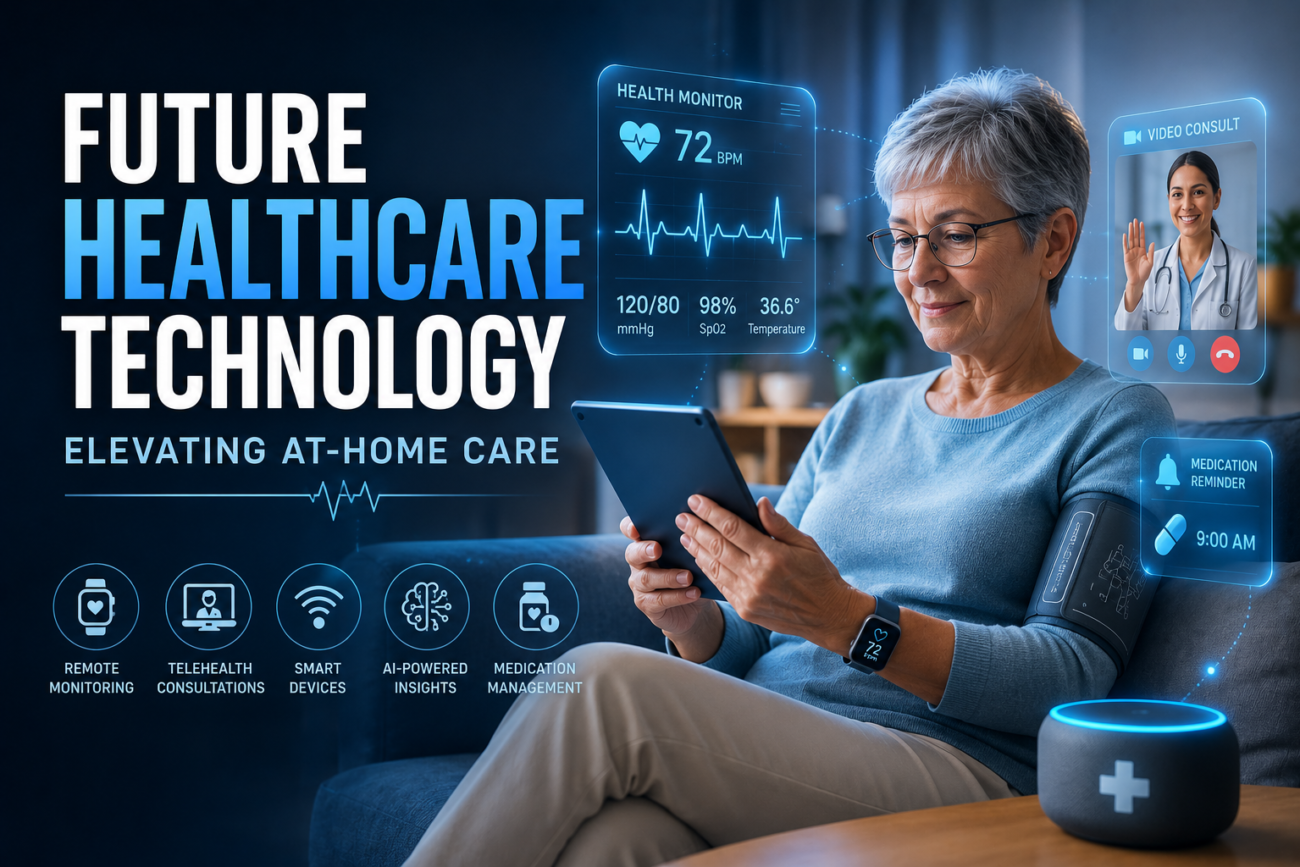
The biggest shift in home healthcare right now isn’t a single device or app — it’s the move from periodic check-ins to continuous monitoring. A blood pressure cuff used once a month at a doctor’s office tells you almost nothing about what happens the other 29 days. A connected device tracking the same vital sign every day, automatically flagging when something drifts out of range, catches problems while they’re still small enough to manage from home.
That shift is what’s actually behind the at-home care boom, more than any individual gadget. Here’s what’s driving it, what it looks like in practice, and where the real friction still is.
Remote Patient Monitoring Is the Foundation
Remote patient monitoring, usually shortened to RPM, is the use of digital devices to collect health data from someone at home and send it electronically to a provider for review. It’s a different thing from a video call with a doctor — telehealth is the scheduled visit, RPM is the continuous stream of data happening in the background while someone just goes about their day.
The scale here is bigger than most people realize. An estimated 48.5 million Americans currently use RPM devices daily to manage chronic conditions from home, and the global RPM market is projected to reach $63.75 billion by 2026. This isn’t a fringe pilot program anymore; it’s becoming a standard piece of how chronic disease gets managed.
The clinical case for it holds up too. A Mayo Clinic study on remote monitoring of heart failure patients found a meaningful drop in hospitalizations, along with a 12% reduction in total cost of care for those patients. That combination — better outcomes and lower cost — is exactly why providers keep expanding these programs instead of treating them as a temporary pandemic-era workaround.
In practice, RPM devices typically track blood pressure, blood oxygen, glucose levels, and heart rhythm, feeding that data back so a care team can intervene before a slow decline turns into an emergency room visit.
Telehealth Has Outgrown the Video Call
Telehealth’s reputation is still partly stuck in 2020, when it meant a doctor’s appointment over Zoom instead of in person. That’s a fraction of what it does now.
Modern telehealth platforms typically connect to electronic health records directly, so a clinician can see real-time data during a virtual visit rather than working from whatever the patient remembers to mention. AI-assisted triage tools now screen symptoms before a consultation even starts, helping route patients to the right type of care faster. E-prescribing lets a doctor send medication orders straight to a pharmacy during the same virtual visit, cutting out a separate phone call or paper script.
The patients who benefit most clearly are the ones who had the hardest time accessing care in the first place — people with mobility limitations, those in rural areas without a nearby specialist, and elderly patients for whom a routine appointment used to mean an entire day built around transportation.
Hospital-at-Home: Acute Care Without the Hospital Stay
This is the part of the shift that sounds the most counterintuitive until you see how it’s structured. Hospital-at-home programs deliver genuinely acute, hospital-level treatment inside a patient’s home, combining remote monitoring, wearables, and telehealth with scheduled in-person visits from nurses or paramedics.
These programs aren’t for everyone. They’re built for patients who are sick enough to need hospital-level care but stable enough to be monitored safely outside a hospital building. Within that group, the results are notable: hospital-at-home models have been associated with cutting costs by more than 30% per admission, along with fewer readmissions and fewer complications compared to a traditional inpatient stay.
The logic behind why this works isn’t purely technological. Patients tend to recover better in familiar surroundings — they sleep better, move around more, eat more normally, and avoid the disorientation and infection risk that come with an extended hospital stay. The technology is what makes monitoring that recovery safely possible from a distance; the better outcomes are partly just what happens when someone heals at home instead of in a ward.
Wearables and Smart Homes for Aging in Place
For older adults specifically, the technology stack tends to combine wearable devices with passive smart-home sensors, rather than relying on either alone.
Wearables now go well beyond step counting — many can detect irregular heart rhythms, falls, or sudden changes in activity level, and alert a family member or care provider automatically when something looks off. Smart home systems layer on top of that with things like automated medication reminders, motion sensors that flag unusual inactivity, and emergency response systems that don’t require the person to actively press a button while in distress.
The goal across all of this is keeping someone safely independent for longer, while giving family members real visibility into a loved one’s day-to-day wellbeing instead of relying on a weekly phone call to gauge how things are going. None of these tools replace a caregiver’s judgment, but they catch the kind of slow changes that are genuinely hard for a family member to notice during occasional visits.
The Policy and Infrastructure Side
None of this scales without the regulatory and infrastructure pieces actually working, and that part is messier than the technology itself.
In the UK, the NHS Long Term Plan has explicitly prioritized moving care closer to home through remote monitoring, virtual wards, and community-based services, treating it as core strategy rather than an experimental add-on. The European Health Data Space regulation, adopted in 2024, is meant to improve health data interoperability across EU and UK systems, which matters because fragmented records are one of the biggest practical barriers to coordinated remote care.
In the US, the picture is more uneven. McKinsey’s 2026 healthcare outlook points to declining Medicaid enrollment tied to regulatory changes and the expiration of pandemic-era coverage protections, with the number of uninsured Americans having risen to 27 million as of 2024 and projections suggesting millions more could lose coverage over the next decade. At the same time, federal programs like the Rural Health Transformation Program are opening new funding specifically for deploying this kind of technology in underserved areas. The tools are maturing faster than the coverage and policy structures meant to support them at scale.
What Still Gets in the Way
A few real obstacles are worth naming plainly rather than glossing over.
Data security is a legitimate concern when health information is constantly flowing between a home device, a cloud platform, and a provider’s system — more connection points mean more places something can go wrong. Reimbursement remains inconsistent, since insurance coverage for remote monitoring and virtual care varies significantly depending on the payer and the state. Technology access gaps are real too — these tools assume reliable internet and at least some comfort with connected devices, which isn’t a safe assumption for every household, especially among older adults living alone. And cross-state licensing rules for telehealth providers still create friction for patients who want to see a specialist outside their home state.
None of these are reasons to dismiss where this is heading, but they’re the actual reasons adoption is uneven rather than universal, and they’re worth knowing if you’re evaluating these tools for yourself or a family member rather than reading about them in the abstract.
Frequently Asked Questions
What’s the difference between telehealth and remote patient monitoring? Telehealth is a scheduled, synchronous interaction — a video visit with a doctor at a specific time. Remote patient monitoring is continuous, asynchronous data collection from devices a patient uses at home, which gets reviewed by a care team without requiring a live appointment.
Is hospital-at-home care actually safe? For the right patients, yes. These programs are specifically designed for people who are sick enough to need hospital-level care but stable enough to be monitored remotely, combining continuous monitoring technology with scheduled in-person visits. They’re not appropriate for every condition or every patient, which is part of why careful eligibility screening is built into how these programs operate.
Does remote monitoring actually reduce hospital visits? Evidence suggests yes for certain chronic conditions. A Mayo Clinic study on heart failure patients found that remote monitoring led to a meaningful reduction in hospitalizations along with lower total cost of care, which is part of why providers continue expanding these programs.
What kind of technology is used for aging in place? A mix of wearable devices (for things like fall detection and irregular heart rhythm alerts) and passive smart-home systems like motion sensors, automated medication reminders, and emergency response tools that don’t require the person to actively trigger them.
Will insurance cover at-home healthcare technology? It depends heavily on the specific service, your insurance provider, and your state. Reimbursement for remote monitoring and telehealth has expanded significantly in recent years but remains inconsistent, so it’s worth confirming coverage directly with your provider before assuming a service is included.
What’s the biggest barrier to wider adoption of these technologies? There isn’t one single barrier — it’s a combination of inconsistent insurance reimbursement, gaps in reliable internet access for some households, data security concerns as more devices connect to health systems, and regulatory friction like cross-state licensing rules for telehealth providers.
