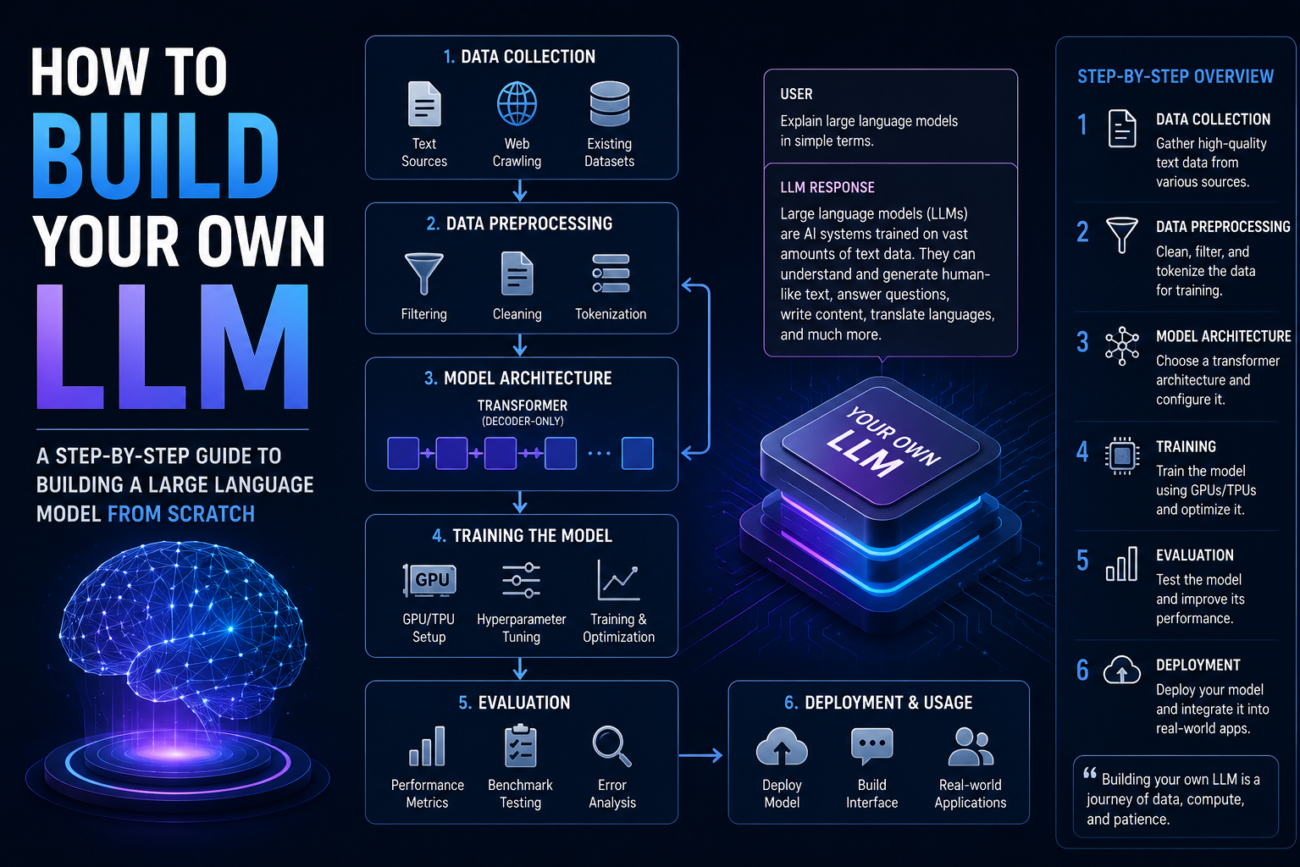
“Build your own LLM” usually means one of three very different things, and figuring out which one you actually mean will save you a lot of wasted time. Pretraining a model from scratch is basically off the table unless you have millions of dollars in compute. Fine-tuning an existing open model on your own data is realistic and is what most people want. And in a lot of cases, you don’t need to train anything at all, you need retrieval-augmented generation (RAG) instead. This guide walks through all three honestly, including what each one really costs.
First, Figure Out Which “Build” You Really Mean
Ask yourself what you’re trying to achieve. If the goal is “I want a model that knows about my company’s documents,” you probably want RAG, not training. If the goal is “I want a model that responds in a specific tone, format, or style consistently,” fine-tuning is the right tool. If the goal is “I want to create a genuinely new foundation model from nothing,” that’s pretraining, and it’s worth being honest with yourself about whether that’s really necessary for what you’re trying to do.
Path 1: Pretraining From Scratch (Probably Not This)
Pretraining means starting with random weights and training a model on a massive text corpus until it learns language from the ground up. This is how Llama, Mistral, Qwen, Gemma, and similar model families got made in the first place, and it’s genuinely the wrong path for almost everyone reading this.
The honest numbers: frontier-class models cost tens to hundreds of millions of dollars in compute alone, run on clusters of thousands of GPUs, take months to train, and require carefully curated datasets measured in trillions of tokens. That’s why the list of organizations that pretrain frontier models from scratch is short, and it’s the same handful of well-funded labs every time.
If you want to understand pretraining mechanically rather than produce something useful, training a tiny model (a few million parameters, on a laptop, on a small text dataset) is a legitimate learning exercise. It just isn’t the same activity as “building your own LLM” in the sense most people mean when they search that phrase.
Path 2: Fine-Tuning an Open Model (This Is Probably What You Want)
Fine-tuning takes an already-trained open-weight model and adapts it to your specific data or task, instead of starting from nothing. This is realistic, often affordable, and is what almost everyone searching “how to build your own LLM” should be doing.
Pick a base model. Llama (Meta), Mistral, Qwen (Alibaba), Gemma (Google), Phi (Microsoft), and DeepSeek are the major open-weight families as of this writing, most released under permissive licenses like Apache 2.0 that allow fine-tuning and commercial use. Which specific model is “best” shifts month to month as labs ship updates, so rather than locking onto one name from this article, check a current leaderboard (Hugging Face’s Open LLM Leaderboard or LMArena are good starting points) when you’re ready to pick.
Pick a size that matches your hardware. Smaller models in roughly the 1B to 14B parameter range run comfortably on a single consumer or prosumer GPU. As a concrete anchor: a 14B model typically fits on an 8GB GPU, and something in the 24-30B range usually needs a 24GB card like an RTX 4090. Going bigger than your hardware can handle is one of the most common reasons people give up on a first attempt.
Use LoRA or QLoRA, not a full fine-tune. A full fine-tune retrains every weight in the model and needs serious GPU memory, often more than any consumer card has. LoRA (and its more memory-efficient variant, QLoRA) trains a small set of additional weights instead of touching the whole model, cutting memory requirements dramatically while still getting you most of the benefit. This is the realistic default for almost everyone outside a well-resourced ML team.
Don’t overestimate how much data you need. A focused task often works with a few hundred to a couple thousand well-made examples. Quality and consistency matter more than raw volume; 300 carefully written examples will usually outperform 3,000 sloppy ones.
Use existing tooling rather than building from scratch. Hugging Face’s Transformers library combined with its PEFT library handles most of the technical heavy lifting. Higher-level wrappers like Axolotl or Unsloth go further and handle a lot of the configuration for you, which is worth it for a first project.
Rent GPU time instead of buying hardware, at least for your first attempt. Cloud GPU providers charge by the hour, and a single fine-tuning run on a focused dataset often finishes in a few hours to a day, which costs far less than buying a GPU outright.
Path 3: Skip Training Entirely With RAG
Retrieval-augmented generation connects an existing model, through an API or one you’re running yourself, to your own documents using a vector database. Instead of baking your knowledge into the model’s weights through training, the system retrieves the relevant chunks of your data at the moment someone asks a question, then hands them to the model along with the question.
This involves no training step at all, which makes it faster to set up and far easier to keep current: updating your knowledge means updating the documents, not retraining anything. RAG is the better fit whenever your actual goal is “I want this to know about specific information,” rather than “I want this to behave or sound a certain way,” which is what fine-tuning is better suited for.
Quick Comparison
| Path | Realistic For | Rough Cost | Time to First Result | Skill Level Needed |
|---|---|---|---|---|
| Pretraining from scratch | Well-funded labs only | Millions+ | Months | Research team |
| Fine-tuning (LoRA/QLoRA) | Most individuals and small teams | $10-$200 in rented GPU time | Hours to a few days | Intermediate, with existing tools doing the heavy lifting |
| RAG (no training) | Knowledge-base style use cases | $0-$50/month in hosting | A day or less | Beginner-friendly |
| Educational tiny pretrain | Learning how it works | Free to a few dollars | A few hours | Beginner, just to see the mechanics |
What You Actually Need If You Go the Fine-Tuning Route
- A clearly defined, narrow task. “Answer customer support questions about our product” works. “Be generally smarter at everything” doesn’t.
- A clean dataset of input/output examples that represent that task, even if it’s only a few hundred examples
- A base model sized to fit the GPU you’re actually using, not the one you wish you had
- LoRA or QLoRA set up through Transformers/PEFT, Axolotl, or Unsloth
- A held-out set of examples you didn’t train on, so you can verify whether it improved rather than guessing from a handful of outputs that looked fine
Fine-Tuning Your Own Model vs. Using a Bigger Model With a Good Prompt
Fine-tuning:
- Pros: consistent tone and format without repeating instructions every time, can run cheaper at scale since you’re not paying premium API rates per request, full control over the model and your data
- Cons: upfront time investment, requires a real dataset, narrows the model’s behavior so it can get worse at tasks outside what you trained it on
Prompting a larger general model (with or without RAG):
- Pros: no training step, you get the broader capability of a frontier-scale model, can iterate on behavior instantly by changing the prompt
- Cons: per-request API costs can add up at high volume, less consistent without careful prompt engineering, you’re dependent on someone else’s model and pricing
For a single well-defined task at meaningful scale, fine-tuning usually wins on cost and consistency. For something exploratory or low-volume, a good prompt against an existing model is almost always the faster path.
Common Mistakes People Make
- Training on too little, or too messy, data. A handful of inconsistent examples teaches the model inconsistency, not your task.
- Picking a model too big for the hardware you have, then spending a week fighting out-of-memory errors instead of training.
- Skipping evaluation. Eyeballing five outputs and deciding it “looks good” isn’t the same as testing against examples the model never saw during training.
- Forgetting that fine-tuning narrows behavior. A model fine-tuned hard on one task can get noticeably worse at general conversation or unrelated tasks. If you need both, consider keeping a separate general-purpose model for everything else.
FAQ
Can I really build my own LLM with no machine learning background? You can fine-tune an existing open model with a moderate learning curve, especially using tools like Axolotl or Unsloth that handle most of the configuration. Pretraining a model from scratch is a different and far more demanding undertaking.
How much data do I actually need to fine-tune a model? Often a few hundred to a couple thousand well-made examples for a focused task. More data helps, but quality and consistency matter more than sheer volume.
Do I need an expensive GPU to fine-tune a model? Not necessarily. Smaller models in the 1B-14B range, fine-tuned with LoRA or QLoRA, run on a single consumer or prosumer GPU, or on a rented cloud GPU by the hour, which is usually the more practical route for a first project.
What’s the difference between fine-tuning and RAG? Fine-tuning changes the model’s weights so it consistently behaves a certain way. RAG leaves the model alone and instead retrieves relevant information from your documents at query time. They solve different problems and can be combined.
Is pretraining a model from scratch ever worth it for an individual or small team? Almost never for a production use case, given the compute cost. It can be worth doing at a tiny, educational scale purely to understand how the mechanics work, but that’s a learning exercise, not a deployable model.
Which open-source model should I start with? Rather than locking onto one name, check a current leaderboard when you’re ready to pick, since rankings among Llama, Mistral, Qwen, Gemma, and similar families shift from month to month. Pick based on your hardware constraints and task first, then choose the strongest model that fits within them.
The Honest Bottom Line
Almost nobody actually needs to pretrain a model from scratch, and most “build your own LLM” goals are solved faster and cheaper with either a fine-tuned open model or a RAG setup that needs no training at all. Figure out which of those two you need before you write a single line of code, and the rest of the process gets a lot more manageable.
