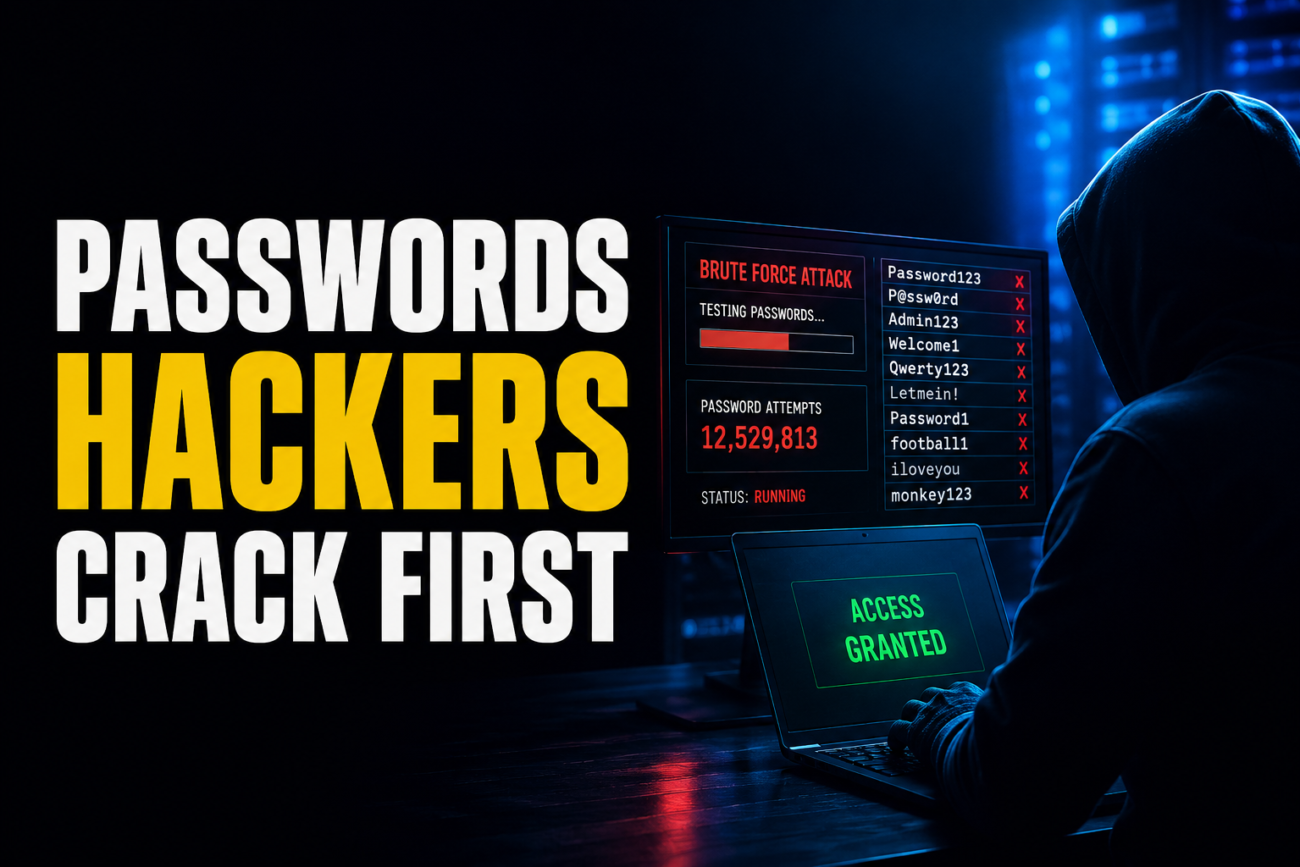
I ran a password I genuinely thought was solid, twelve characters, mixed case, a number, a symbol, through a cracking-time estimator a while back and watched it come back as “instantly” crackable. The reason had nothing to do with the character types I’d used and everything to do with the fact that it was a real word with predictable substitutions, the kind of pattern cracking tools are specifically built to catch first. That gap between what feels strong and what actually resists cracking is exactly what I wanted to understand properly.
Quick Answer
- Modern password cracking runs on GPU clusters, not a hacker manually guessing. A cluster of a dozen high-end graphics cards can test hundreds of billions of hash combinations per second against weakly hashed passwords, according to Hive Systems research.
- Length matters far more than complexity for resisting brute force specifically. An 8-character password with symbols can fall in minutes on modern hardware, while a longer, simpler passphrase can remain impractical to crack through sheer combinatorial math.
- The techniques that actually stop most real-world account compromise aren’t exotic. Multi-factor authentication, unique passwords per site, and avoiding predictable patterns based on real words address the methods attackers actually use most often.
The Six Ways Attackers Actually Try to Get In
Password cracking isn’t one technique, it’s a toolbox, and attackers pick the tool that fits the situation. Security researchers generally group these into six main variants: simple brute force, dictionary attacks, credential stuffing, password spraying, reverse brute force, and hybrid attacks. Each one exploits a different weakness, which is part of why defending against just one doesn’t cover you against the rest.
Simple brute force tries every possible character combination systematically until one works. It’s slow in theory but devastatingly fast in practice against short passwords, since modern GPU hardware was built for exactly this kind of parallel computation. Dictionary attacks skip random guessing entirely and instead run through lists of real words, common passwords, and known breach data, testing each one directly. Credential stuffing doesn’t guess at all: it takes username and password pairs already exposed in a previous breach and tries them against other sites, betting on password reuse. Password spraying flips the usual approach, trying one common password across many accounts rather than many passwords against one account, which helps attackers avoid triggering account lockout policies. Reverse brute force works similarly, starting from a known password and searching for which username it belongs to. Hybrid attacks combine dictionary words with brute-force pattern testing, which is exactly what catches passwords like “Password123!” that feel complex but follow an entirely predictable structure.
[COMMON TRAP] Don’t assume adding a symbol or number to a common word makes it meaningfully harder to crack. Hybrid attacks are specifically designed to test dictionary words with predictable modifications, capitalizing the first letter, appending “123” or “!”, swapping “a” for “@”. These substitutions feel clever but are exactly the pattern cracking wordlists are built around, since so many people make the same predictable changes.
Why Modern Hardware Changed the Math Entirely
This is the part that’s shifted the most in the last few years, and it’s worth understanding concretely. Graphics cards, originally built for gaming and machine learning, turn out to be extremely efficient at the parallel computation password cracking requires. According to Hive Systems research, a cluster of 12 NVIDIA RTX 5090 GPUs can test hundreds of billions of MD5 hash combinations per second against weakly hashed credentials. Against that kind of hardware, an 8-character password, even with mixed case, numbers, and symbols, can fall in minutes if it’s protected only by a fast, unsalted hashing algorithm.
Password length is what actually creates meaningful resistance here, more than character complexity alone. Each additional character multiplies the total number of possible combinations, while adding character types (uppercase, symbols) increases it by a much smaller factor per character. A genuinely long passphrase built from unrelated words can be dramatically harder to brute force than a short, complex-looking password, even though the short one looks more “secure” at a glance.
| Attack Type | How It Works | What Stops It |
|---|---|---|
| Simple brute force | Tests every character combination | Password length, rate limiting, account lockout |
| Dictionary attack | Tests known words and common passwords | Avoiding real words and predictable phrases |
| Credential stuffing | Reuses breached username/password pairs | Unique password per site, breach monitoring |
| Password spraying | Tries one common password across many accounts | Avoiding common/predictable passwords entirely |
| Hybrid attack | Dictionary words with pattern modifications | Avoiding predictable substitutions (@, 123, !) |
| Rainbow table attack | Precomputed hash lookups | Properly salted password hashing (service-side) |
[PRO TIP] Check whether a service you use has actually been part of a known data breach using a tool like Have I Been Pwned, and if a password you’re still using anywhere shows up there, change it immediately, everywhere it’s reused, not just on the breached site. Credential stuffing specifically relies on the assumption that a password compromised on one site is still active on others, and that assumption is correct often enough to make it one of the most effective attack methods in active use.
Why Salting and Hashing Matter More Than You’d Think
A lot of what determines whether your password actually gets cracked has nothing to do with the password itself, it depends on how the service storing it protects that data. Rainbow table attacks work by comparing a stolen password database against massive precomputed tables of hash values, which lets an attacker skip the actual cracking process entirely for weakly protected passwords. Salting, adding random data to each password before it’s hashed, defeats this specific technique by making precomputed tables useless, since the same password produces a different hash on every system.
This is genuinely outside your control as a user, which is exactly why relying on a strong password alone isn’t a complete defense. A breach at a company using outdated, unsalted hashing can expose even a well-constructed password to cracking, which is part of why the same password should never protect more than one account.
(Compared using: published Hive Systems password-cracking benchmark data, cross-referenced against Fortinet, Darktrace, and Rapid7’s technical breakdowns of brute force and dictionary attack methodology)
Troubleshooting Common Password Security Situations
You reused a password across multiple sites and just learned one of them was breached. Change that password everywhere it’s used immediately, not just on the breached service, and treat every account using that same password as potentially compromised until changed. Credential stuffing tools work through breach data almost immediately after it becomes available.
You’re not sure if your current passwords would actually hold up against modern cracking speeds. A password manager’s built-in strength checker, or a reputable password strength estimator, gives a more realistic picture than eyeballing whether a password “looks” complex. Length and uniqueness across accounts matter more than checking every complexity box on a single password.
You keep getting locked out because you’re trying to make every password maximally complex and can’t remember them. This is exactly the problem password managers solve. Generating and storing long, unique, random passwords per account removes the memorization burden entirely, which is more sustainable long-term than reusing a slightly modified version of the same memorable password everywhere.
FAQ
How fast can a modern computer actually crack a password? It depends heavily on password length, complexity, and how the service hashes it. Against weakly hashed credentials, GPU clusters can test hundreds of billions of combinations per second, meaning short, simple passwords can fall in minutes, while long, properly hashed passwords can remain computationally impractical to crack directly.
Does adding a symbol or number to my password actually help? Somewhat, but far less than most people assume, particularly if the addition follows a predictable pattern like appending “123” or “!” to a real word. Hybrid attacks are specifically built to test exactly these common modifications.
Is a long passphrase actually more secure than a short complex password? Generally yes, against brute force specifically, since each additional character multiplies the total combinations far more than adding character variety to a shorter password does. A long passphrase built from unrelated words also tends to be easier to remember than a short, complex, hard-to-recall string.
What’s the single most effective thing I can do to protect my accounts? Multi-factor authentication, combined with unique passwords per account. MFA specifically defeats most cracking and credential stuffing attempts even if a password is compromised, since the attacker still lacks the second verification factor.
Can a company’s poor security practices put my strong password at risk anyway? Yes. If a service stores passwords with weak or unsalted hashing, a breach there can expose your password to cracking regardless of how strong it was, which is exactly why reusing passwords across sites multiplies your risk beyond what any single strong password can offset.
Are password managers actually safe to use for this? Generally yes, and they solve the core tradeoff between password strength and memorability by generating and storing long, unique, random passwords you don’t have to remember individually, removing the temptation to reuse or simplify passwords for convenience.
Conclusion
Modern password cracking runs on hardware built for entirely different purposes, and it’s fast enough that the old advice, add a symbol, capitalize a letter, feels almost quaint against GPU clusters capable of hundreds of billions of guesses per second. What actually resists this is length over cleverness, uniqueness across accounts over memorable reuse, and multi-factor authentication as a backstop for when a password gets compromised anyway, since eventually, somewhere, one probably will.
If securing your accounts is part of a broader home security cleanup, it’s worth reading how to secure your home Wi-Fi router next, and if you’ve ever wondered whether Face ID or a fingerprint is actually a stronger defense than a password in the first place, is biometric login actually more secure than a password covers that comparison directly.
